Trabajar con períodos puede resultar confuso. Imagina que tienes una aplicación de contabilidad. Y necesita obtener los períodos en los que el empleado trabajó en el programa "2 a 2" antes de la indexación salarial. En este caso, es necesario tener en cuenta vacaciones, cambios en los horarios de trabajo, bajas / reintegros, traslados a otros departamentos y otras actividades del personal. Esta información se almacena en forma de pedidos, que tienen una "Fecha de inicio" y una "Fecha de finalización", es decir. tiene períodos de tiempo para operar.
Por ejemplo, encuentre la intersección de todos los intervalos:
2 5 7 9
|--------------| |---------|
0 3 4 6 7 10
|--------------| |---------| |--------------|
1 4 5 8
|--------------| |--------------|
Result
2 3 7 8
|----| |----|
//
La utilidad anunciada está destinada a resolver este tipo de problemas.
Trabajar con períodos en la representación visual es mucho más fácil, por lo que para las pruebas (también hay un conjunto de pruebas) y la documentación, hice una generación simple de imágenes ASCII, como se muestra arriba.
, ASCII y=f(x).
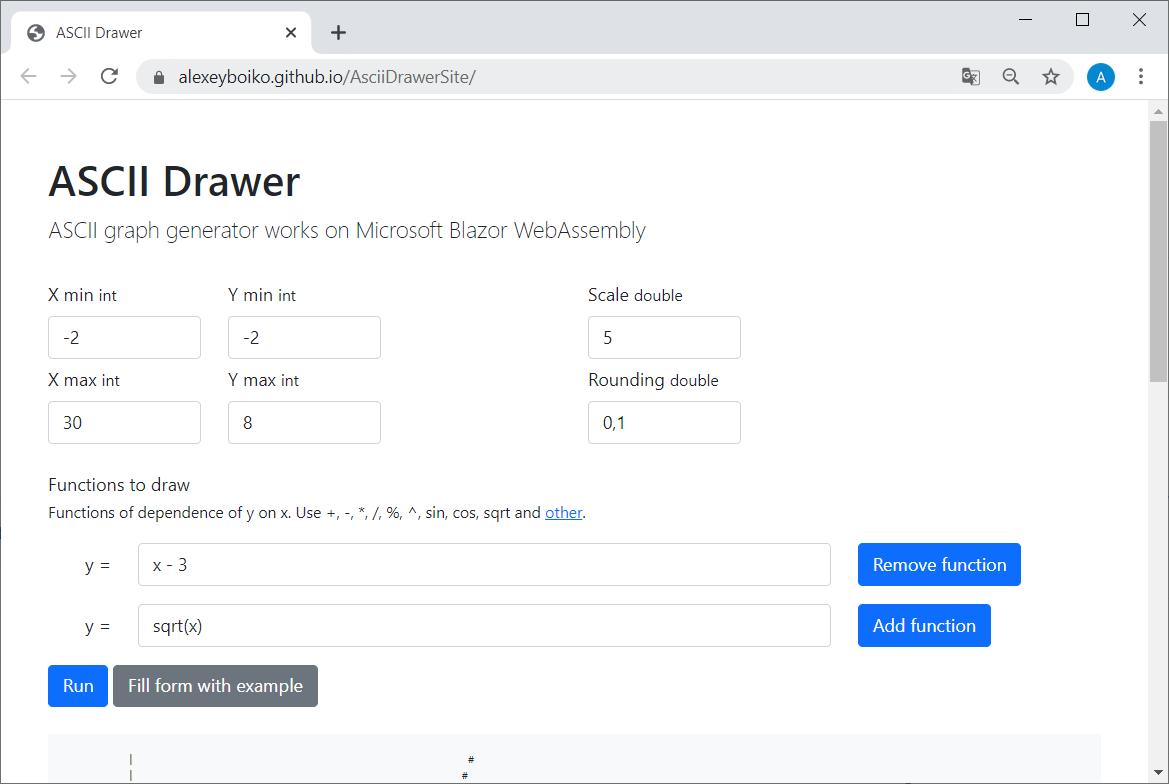
1. ASCII Blazor WebAssembly. y x.
IntervalUtility
GitHub, NuGet, demo Blazor WebAssembly.
. GitHub.
var arrayOfArrays = new[] {
new[] { new Interval<int>(2,5), new Interval<int>(7, 9) },
new[] { new Interval<int>(0,3), new Interval<int>(4, 6),
new Interval<int>(7, 10) },
new[] { new Interval<int>(1,4), new Interval<int>(5, 8) },
};
var intervalUtil = new IntervalUtil();
var res = intervalUtil.Intersections(arrayOfArrays);
// => [2,3], [7,8]
2 5 7 9
|--------------| |---------|
0 3 4 6 7 10
|--------------| |---------| |--------------|
1 4 5 8
|--------------| |--------------|
Result
2 3 7 8
|----| |----|
var intervalsA = new[] { new Interval<int>(1, 5), new Interval<int>(7, 10) };
var intervalsB = new[] { new Interval<int>(0, 2), new Interval<int>(3, 5),
new Interval<int>(8, 9) };
var intervalUtil = new IntervalUtil();
var res = intervalUtil.Exclude(intervalsA, intervalsB);
// => [2,3], [7,8], [9,10]
1 5 7 10
|-------------------| |--------------|
0 2 3 5 8 9
|---------| |---------| |----|
Result
2 3 7 8 9 10
|----| |----| |----|
. ASCII .
ASCII
demo Blazor WebAssembly.
“ ”. /. , “ ”, , “ ” - .
: “ ASCII” ,
( ). “” . . - . . - .
, :
,
, , .
/ , .
public class DrawerProcessor {
public void Draw(
//
Func<int, int, DrawerBlock> blockDraw,
//
Action<string, bool> onBlockDraw) {
int row = 0;
int blockIndex = 0;
var done = false;
while (!done) {
var block = blockDraw(row, blockIndex);
switch (block.Command) {
case DrawerCommand.Continue:
blockIndex = blockIndex + block.Displacement;
break;
case DrawerCommand.NewLine:
row = row + 1;
blockIndex = 0;
break;
case DrawerCommand.End:
done = true;
break;
}
onBlockDraw(block.Value, done);
}
}
}
public class DrawerBlock {
public string Value { get; set; }
public DrawerCommand Command { get; set; }
// ,
// Value
// Value 2
public int Displacement { get; set; } = 1;
}
DrawerProcessor . DrawerProcessor :
,
,
.
DrawerProcessor:
var drawer = new DrawerProcessor();
drawer.Draw(
(row, blockIndex) => {
//
if (row == 3)
return new DrawerBlock {
Command = DrawerCommand.End
};
if(blockIndex == 3)
return new DrawerBlock {
Value = Environment.NewLine,
Command = DrawerCommand.NewLine
};
return new DrawerBlock {
Value = $"[{row},{blockIndex}]",
Command = DrawerCommand.Continue
};
},
(blockStr, isEnd) => Console.Write(blockStr)
);
[0,0][0,1][0,2]
[1,0][1,1][1,2]
[2,0][2,1][2,2]
// 1. DrawerProcessor.
// -
// ( (row, blockIndex) => { .. }),
// .
, , DrawerBlock.Displacement? - 1 , :
8 11
|---------|
“11” - . “11” - , “ “11”, “1” - “1” ”. ? “11” : DrawerBlock.Displacement = 2.
: “11” , (, -). ( “1” - “1”), .. " ". .
:
static class Block {
public static DrawerBlock Continue(string val, int displacement = 1)
=> new() {
Command = DrawerCommand.Continue,
Value = val,
Displacement = displacement
};
public static DrawerBlock End() =>
new() { Command = DrawerCommand.End };
public static DrawerBlock NewLine() =>
new() {
Command = DrawerCommand.NewLine,
Value = Environment.NewLine
};
}
:
return new DrawerBlock {
Value = Environment.NewLine,
Command = DrawerCommand.NewLine
};
:
return Block.NewLine();
1 ( (row, blockIndex) => { .. }). , . , / - (row, blockIndex) => { .. } .
: 1 :
[0,0][0,1][0,2]
[1,0][1,1][1,2]
[2,0][2,1][2,2]
:
[ ][0,1][ ]
[1,0][ ][1,2]
[ ][2,1][ ]
(row, blockIndex) => { .. }.
: “ /” - , .. “ ” - . “ ” - .
.. , (. ), . .
. (“ ”, “ ”, “ ”, “ ”) ().
// ""
DrawerBlock end(int row, int blockIndex) =>
row == 3 ? Block.End() : null;
// " "
DrawerBlock newLine(int row, int blockIndex) =>
blockIndex == 3 ? Block.NewLine() : null;
// " "
DrawerBlock brick(int row, int blockIndex) =>
Block.Continue($"[{row},{blockIndex}]");
:
public class BlockDrawer {
readonly DrawerProcessor _DrawerProcessor;
public BlockDrawer(DrawerProcessor drawerProcessor) {
_DrawerProcessor = drawerProcessor
?? throw new ArgumentNullException(nameof(drawerProcessor));
}
public void Draw(
IReadOnlyCollection<Func<int, int, DrawerBlock>> blockDrawers,
Action<string, bool> onBlockDraw) {
_DrawerProcessor.Draw(
(row, blockIndex) => {
foreach (var bd in blockDrawers) {
var block = bd(row, blockIndex);
if (block != null)
return block;
}
return
new DrawerBlock { Command = DrawerCommand.End };
},
onBlockDraw
);
}
}
:
// :
var blockDrawers = new Func<int, int, DrawerBlock>[] {
end,
newLine,
brick
};
var drawer = new DrawerProcessor();
var blockDrawer = new BlockDrawer(drawer);
blockDrawer.Draw(
blockDrawers,
(blockStr, isEnd) => Console.Write(blockStr));
, 1 - .
:
static void Main(string[] args) {
DrawerBlock end(int row, int blockIndex) => ...;
DrawerBlock newLine(int row, int blockIndex) => ...;
DrawerBlock brick(int row, int blockIndex) => ...;
//
DrawerBlock brickEmpty(int row, int blockIndex) =>
((row + blockIndex) % 2 == 0) ? Block.Continue($"[ ]") : null;
var blockDrawers = new Func<int, int, DrawerBlock>[] {
end,
newLine,
brickEmpty, // brick
brick
};
var drawer = new DrawerProcessor();
var blockDrawer = new BlockDrawer(drawer);
blockDrawer.Draw(
blockDrawers,
(blockStr, isEnd) => Console.Write(blockStr));
}
[ ][0,1][ ]
[1,0][ ][1,2]
[ ][2,1][ ]
// 2. DrawerProcessor.
// .
// main - ,
// .
: “ ”. . . , . , - .
2 Main. Main. . .
public interface IContextDrawerBlock<TDrawerContext> {
int Priority { get; }
DrawerBlock Draw(int row, int blockIndex, TDrawerContext context);
}
context, . , - context.RowCount:
class EndDrawer : IContextDrawerBlock<SampleDrawContext> {
public int Priority => 10;
public DrawerBlock Draw(int row, int blockIndex,
SampleDrawContext context)
=> row == context.RowCount ? Block.End() : null;
}
, :
public class ContextBlockDrawer<TDrawerContext> {
readonly IReadOnlyCollection<IContextDrawerBlock<TDrawerContext>> _BlockDrawers;
readonly BlockDrawer _Drawer;
public ContextBlockDrawer(
BlockDrawer drawer,
IReadOnlyCollection<IContextDrawerBlock<TDrawerContext>> blockDrawers) {
_Drawer = drawer ?? throw ...
_BlockDrawers = blockDrawers?.Any() == true
? blockDrawers.OrderBy(bd => bd.Priority).ToArray()
: throw ...
}
public void Draw(TDrawerContext drawerContext,
Action<string, bool> onBlockDraw) {
var drawers = _BlockDrawers.Select(bd => {
DrawerBlock draw(int row, int blockIndex) =>
bd.Draw(row, blockIndex, drawerContext);
return (Func<int, int, DrawerBlock>)draw;
})
.ToArray();
_Drawer.Draw(drawers, onBlockDraw);
}
}
:
// ContextBlockDrawer
var drawer = new DrawerProcessor();
var blockDrawer = new BlockDrawer(drawer);
var blockDrawers = new IContextDrawerBlock<SampleDrawContext>[] {
new EndDrawer(),
new EndLineDrawer(),
new BrickEmptyDrawer(),
new BrickDrawer(),
};
var ctxBlockDrawer = new ContextBlockDrawer<SampleDrawContext>(
blockDrawer,
blockDrawers);
// ContextBlockDrawer
ctxBlockDrawer.Draw(
new SampleDrawContext {
RowCount = 3,
BlockCount = 3
},
(blockStr, isEnd) => Console.Write(blockStr));
// 3. ContextBlockDrawer.
// .
// .
// ,
// - Priority.
: Priority, Priority . “ ”. .. ( ).
,
ContextBlockDrawer 3. ContextBlockDrawer () BlockDrawer . BlockDrawer, , () DrawerProcessor, .
:
ContextBlockDrawer -> ( )-> BlockDrawer -> -> DrawerProcessor.
“”.
3 ContextBlockDrawer “ ”. ( ) : “ ”:
- , ( - )
- , .
: , , “ ”:
//
// ( )
var ctxBlockDrawer = new ContextBlockDrawer();
ctxBlockDrawer.BlockDrawer = blockDrawer;
//
// ( )
public class ContextBlockDrawer<TDrawerContext> {
...
public void Draw(TDrawerContext drawerContext,
Action<string, bool> onBlockDraw) {
...
var blockDrawer = ServiceLocator.Get<BlockDrawer>();
...
}
}
//
BlockDrawer (), ContextBlockDrawer BlockDrawer ( ):
public class ContextBlockDrawer<TDrawerContext> {
readonly IReadOnlyCollection<IContextDrawerBlock<TDrawerContext>> _BlockDrawers;
readonly BlockDrawer _Drawer;
public ContextBlockDrawer(
IReadOnlyCollection<IContextDrawerBlock<TDrawerContext>> blockDrawers) {
//
var drawer = new DrawerProcessor();
_Drawer = new BlockDrawer(drawer);
...
}
ContextBlockDrawer BlockDrawer : ContextBlockDrawer BlockDrawer, BlockDrawer. BlockDrawer( DrawerProcessor). .. , .
y x ContextBlockDrawer , :
public interface IContextDrawerBlock<TDrawerContext> {
int Priority { get; }
DrawerBlock Draw(int row, int blockIndex, TDrawerContext context);
}
Draw row blockIndex. . y :
public interface IartesianDrawerBlock<TDrawerContext> {
int Priority { get; }
DrawerBlock Draw(float x, float y, TDrawerContext context);
}
, :
class LineDrawer : IartesianDrawerBlock<artesianDrawerContext> {
public int Priority => 40;
public DrawerBlock Draw(float x, float y,
artesianDrawerContext context) {
var y1 = x; // y=x
// y1 y
// (c )
if (Math.Abs(y1 -y) <= context.Rounding)
return Block.Continue("#");
return null;
}
}
IartesianDrawerBlock ContextBlockDrawer. , “Draw(int row, int blockIndex, TDrawerContext context)” “DrawerBlock Draw(float x, float y, TDrawerContext context)”:
public class artesianDrawerAdapter<TDrawerContext> :
IContextDrawerBlock<TDrawerContext>
where TDrawerContext : IartesianDrawerAdapterContext {
readonly IartesianDrawerBlock<TDrawerContext> _cartesianDrawer;
public artesianDrawerAdapter(
IartesianDrawerBlock<TDrawerContext> cartesianDrawer) {
_cartesianDrawer = cartesianDrawer ?? throw ...
}
public int Priority => _cartesianDrawer.Priority;
public DrawerBlock Draw(int row, int blockIndex, TDrawerContext context) {
float x = blockIndex / context.Scale + context.XMin;
float y = context.YMax - row / context.Scale;
return _cartesianDrawer.Draw(x, y, context);
}
}
public interface IartesianDrawerAdapterContext {
public float Scale { get; }
public float XMin { get; }
public float YMax { get; }
}
artesianDrawerAdapter - :
// ctxBlockDrawer
var drawer = new DrawerProcessor();
var blockDrawer = new BlockDrawer(drawer);
var blockDrawers = new IartesianDrawerBlock<artesianDrawerContext>[] {
new EndDrawer(),
new EndLineDrawer(),
new LineDrawer(),
new EmptyDrawer()
}
.Select(dd =>
//
new artesianDrawerAdapter<artesianDrawerContext>(dd))
.ToArray();
var ctxBlockDrawer = new ContextBlockDrawer<artesianDrawerContext>(
blockDrawer,
blockDrawers);
// ctxBlockDrawer
ctxBlockDrawer.Draw(new artesianDrawerContext {
XMin = -2,
XMax = 30,
YMin = -2,
YMax = 8,
Scale = 5,
Rounding = 0.1F
},
(blockStr, isEnd) => Console.Write(blockStr));
: IContextDrawerBlock IartesianDrawerBlock “” - artesianDrawerAdapter.
:
//
...
var ctxBlockDrawer = ...
var asciiDrawer =
new AsciiDrawer<artesianDrawerContext>(ctxBlockDrawer);
//
asciiDrawer
//
.OnBlockDraw((blockStr, isEnd) => Console.Write(blockStr))
.Draw(new artesianDrawerContext {
XMin = -2,
XMax = 30,
...
});
// 4. AsciiDrawer.
AsciiDrawer:
public class AsciiDrawer<TDrawerContext> {
readonly ContextBlockDrawer<TDrawerContext> _ContextBlockDrawer;
readonly Action<string, bool> _onBlockDraw;
public AsciiDrawer(
ContextBlockDrawer<TDrawerContext> contextBlockDrawer,
Action<string, bool> onBlockDraw = null) {
_ContextBlockDrawer = contextBlockDrawer ?? throw ...
_onBlockDraw = onBlockDraw;
}
public AsciiDrawer<TDrawerContext> OnBlockDraw(
Action<string, bool> onBlockDraw) {
//
// this (return this)
return new AsciiDrawer<TDrawerContext>(
_ContextBlockDrawer,
onBlockDraw);
}
public void Draw(TDrawerContext context) {
if (_onBlockDraw == null)
throw new InvalidOperationException("Use .OnBlockDraw to set up draw output");
_ContextBlockDrawer.Draw(context, _onBlockDraw);
}
}
: AsciiDrawer “” - , . OnBlockDraw ( this). “” .
SingleInstance
4 , “”, IoC . AsciiDrawer.
Los objetos ASCII del pintor no almacenan estados, también son "inmutables", lo que significa que puede usar las mismas instancias de forma segura en diferentes lugares. Incluyendo nuestros objetos, se pueden registrar en el contenedor de IoC como SingleInstance.
Como resultado, en la demostración de Blazor WebAssembly, haga clic en el botón Ejecutar, el siguiente código:
var res = new StringBuilder();
AsciiDrw
.OnBlockDraw((blockStr, isEnd) => {
res.Append(blockStr);
if (isEnd)
// UI
Res = res.ToString();
})
.Draw(new FuncsDrawerContext {
//
Rounding = Rounding,
Scale = Scale,
XMin = Xmin,
XMax = Xmax,
YMin = Ymin,
YMax = Ymax,
// y x
Functions = funcs
});
La demostración utiliza los siguientes bloques:
new EndDrawer(),
new EndLineDrawer(),
new FuncsDrawer(), //
new XAxisDrawer(), // X
new YAxisDrawer(), // Y
new EmptyDrawer()
También puedes pensar en:
un bloque que pinta el área debajo del gráfico,
un bloque que muestra una escala en los ejes,
bloque que señala los puntos de intersección de las gráficas.
Conclusión
Como puede ver, incluso un problema escolar puede confundirse seriamente: lo principal es conocer los principios y patrones.