Descripción
Las redes neuronales profundas han demostrado ser efectivas para procesar datos sensoriales como imágenes y audio. Sin embargo, para los datos tabulares, los modelos de árbol son más populares. Una buena propiedad de los modelos de árboles es su interpretabilidad natural. En este artículo, presentamos los árboles de decisión neuronales profundos (DNDT): modelos de árbol implementados por redes neuronales. DNDT se interpreta internamente como un árbol. Sin embargo, dado que también es una red neuronal (NN), se puede implementar fácilmente con el kit de herramientas de NN y entrenar usando un algoritmo de descenso de gradiente en lugar de un algoritmo codicioso (un algoritmo de particionamiento codicioso). Evaluamos DNDT en múltiples conjuntos de datos tabulares, probamos su efectividad y exploramos las similitudes y diferencias entre DNDT y árboles de decisión convencionales. Interesante,que DNDT es autoaprendizaje tanto a nivel dividido como funcional.
Introducción
La interpretabilidad de los modelos predictivos es importante, especialmente cuando se trata de la ética: aplicaciones legales, médicas y financieras de misión crítica en las que queremos verificar manualmente la relevancia del modelo. Las redes neuronales profundas (Lecun et al., 2015 [18]; Schmidhuber, 2015 [25]) han logrado excelentes resultados en muchas áreas como la visión por computadora, el procesamiento del habla y el modelado del lenguaje. Sin embargo, la falta de interpretabilidad no permite que esta familia de modelos sea utilizada en aplicaciones como una “caja negra” para lo cual necesitamos conocer el procedimiento de pronóstico para verificar el proceso de toma de decisiones. Además, en algunas áreas, como la inteligencia empresarial (BI), a menudo es más importante saber cómo afecta cada factor al pronóstico que a la conclusión en sí. Métodos basados en árboles de decisión (DT) como C4.5 (Quinlan,1993 [23]) y CART (Breiman et al., 1984 [5]), tienen una clara ventaja en este aspecto, ya que la estructura del árbol se puede rastrear fácilmente y con precisión cómo se hace el pronóstico.
– (DNDT), . DNDT- , DNDT . , DNDT (NN), , DT: DNDT NN; , «» . DNDT - GPU « », NN (back-propagation).
2.
. , , . / . C4. 5 (Quinlan, 1993 [23]) CART (Breiman et al., 1984 [5]). , , . , « » (Breiman, 2001 [6]) XGBoost (Chen & Guestrin, 2016 [8]), . .
. , , , (, ) , (Weller, 2017 [26]; Doshi-Velez, 2017 [11]). , (Bostrom & Yudkowsky, 2014 [4]) , , . . - (Ribeiro et al., 2016 [24]), , , (Dash et al., 2015 [10]; Malioutov et al., 2017 [19]), (Kim et al., 2016 [15]) (Kim et al., 2017 [16]).
. . Bul & Kontschieder (2014) [7] « » ( Neural Decision Forests NDF) , . Deep-NDF (Kontschieder et al., 2015 [17]) , ( CNNs) ( ). DNDT . -, () ( ). (back propagation). -, ( ), , (≥ 2) . , , , , . , (Bul & Kontschieder, 2014 [7]; Kontschieder et al., 2015 [17]) . . , Kontschieder et al. (2015 [17]), , , .
, (2017 [2]), «» , . «» , «» , , .
. DT «» (Quinlan, 1993; Breiman et al., 1984 [23]). , «» (Norouzi et al., 2015 [20]). , , (Norouzi et al., 2015 [20]) RNN (Xiong et al., 2017 [28]). , DNDT , , , DT, SGD. , , DT ( ), DNDT , .
3.
3.1.
, , - (Dougherty et al., 1995) (), DNDT. , x , . , .
, x, N + 1 . n , . [β1, β2,…, βn] , β1 < β2 < · · · < βn. β , . , β.
softmax.

w- , , w = [1; 2; : : : ; n + 1]. b ,

τ> 0 - . τ → 0 .
,



x

, 1 «» x, . , « » (Chung et al., 2017 [9]), , , , .
- «» ( ) , Straight-Through (ST) Gumbel-Softmax (Jang et al., 2017): , Gumbel-Max, (backward pass) Gumbel-Softmax (. Bengio (2013 [3]) .
.1 , x [0, 1] 0.33 0.66 . 1 2, o1 = x, o2 = 2x − 0.33, o3 = 3x − 0.99.
![1. 0.33 0.66. x - x2 [0; 1]. : ; : softmax = 1; : = 0.1; : = 0.01.](https://habrastorage.org/getpro/habr/upload_files/ab5/1bd/c1f/ab51bdc1f73be966aff6556d810533d3.PNG "1. 0.33 0.66. x - x2 [0; 1]. : ; : softmax = 1; : = 0.1; : = 0.01.")
3.2
, , ⊗. ,

xd fd (xd), ,

z «» , , x. , , z . DNDT . 2.
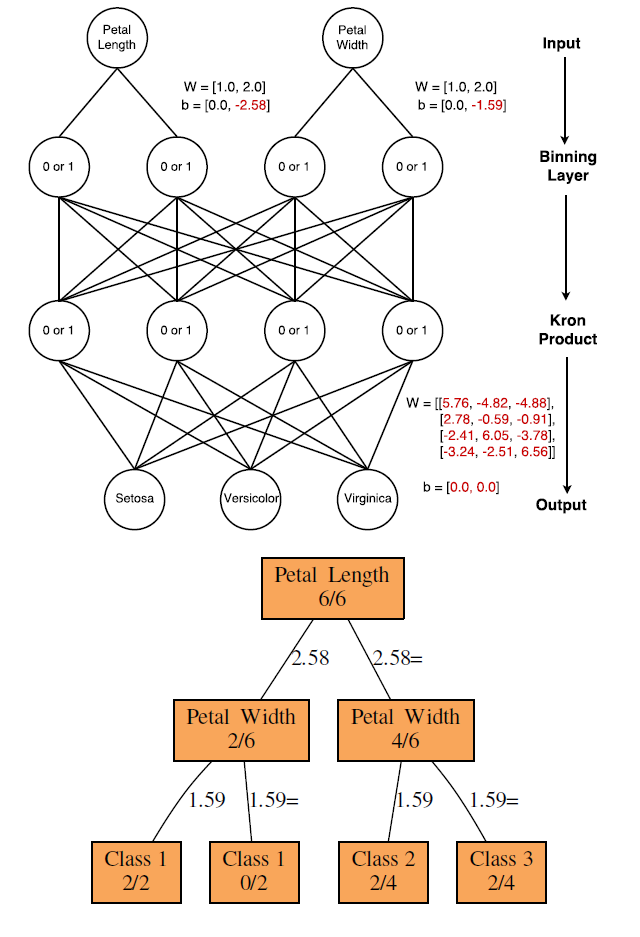
3.3
. , . , (. 2, ) SGD.
. DNDT - . , - Kronecker . "" , «» (Ho, 1998 [13]) - . , . , «», : , . DNDT.
4.
4.1
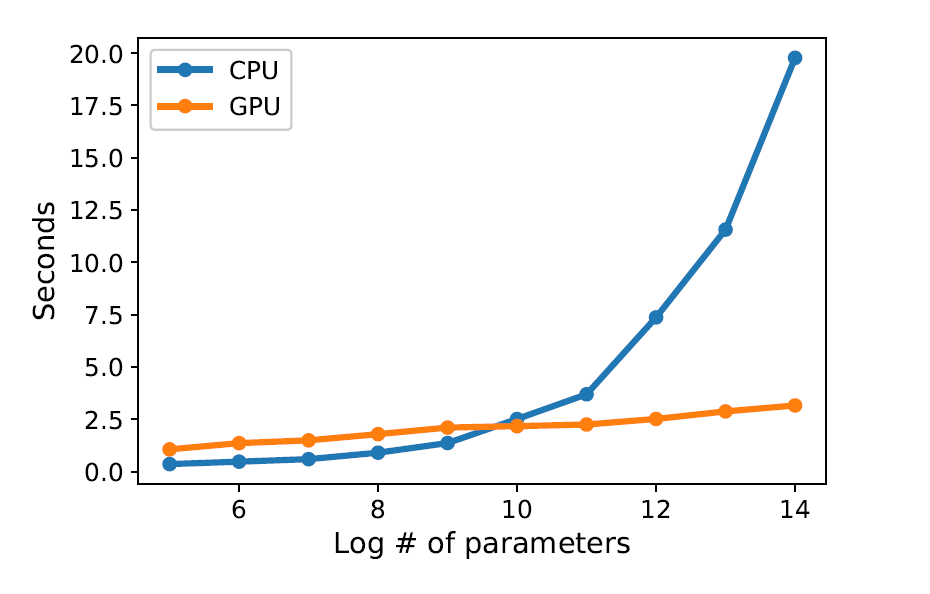
DNDT ≈ 20 TensorFlow PyTorch. , DNDT " " GPU - , , .
4.2
DNDT ( TensorFlow (Abadi et al., 2015) [1]) ( Scikit-learn (Pedregosa et al., 2011 [22])) 14 , Kaggle UCI ( . . 1).
(DT) : 'gini' – 'best'. (NN) 50 . DNDT - ( ), 1 . 4.4. 12 , DNDT, 10 , 10 . .
4.3
DNDT, . 1. .2.
DT. DT , , .
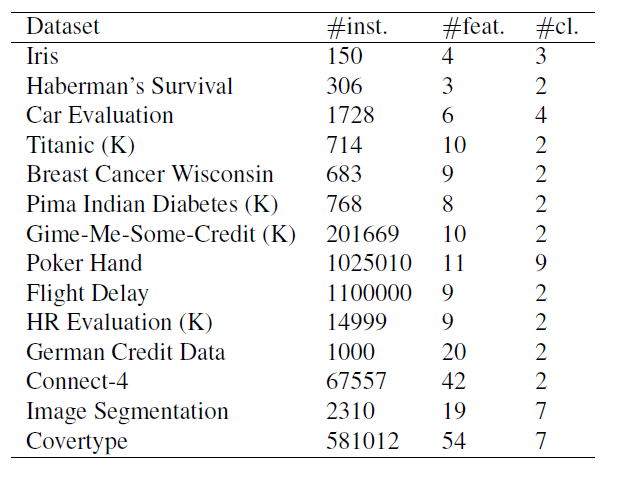

, . DNDT , «» , . , , . , . « » (Wolpert, 1996[27]).
4.4
DNDT . , , , , xd, xd.
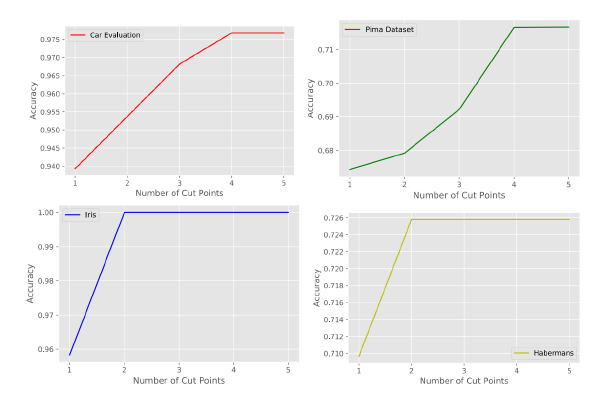
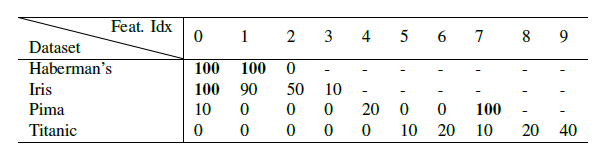
, DNDT. , . -Car Evaluation, Pima, Iris Haberman 1 5 , . 3. , . , DNDT : .
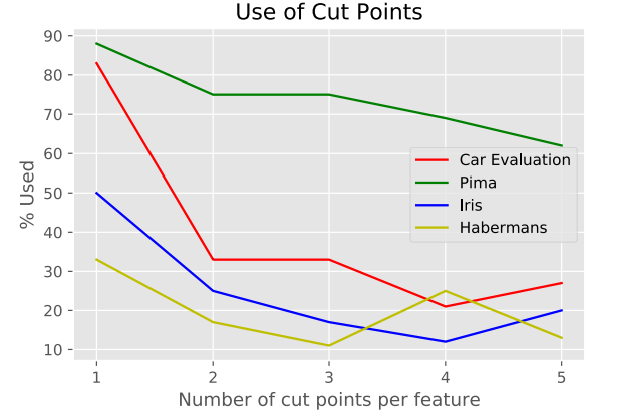
, . . 4, , . , , DNDT , .
4.5
DNDT , . , , DT, , - . , DNDT . DNDT 10 , - , .
- , , (, 0 iris) DNDT (. . 3 ). , DNDT , . () : , , , .
4.6
, 4.5, , DNDT DT . gini (), (. 5), (.3).
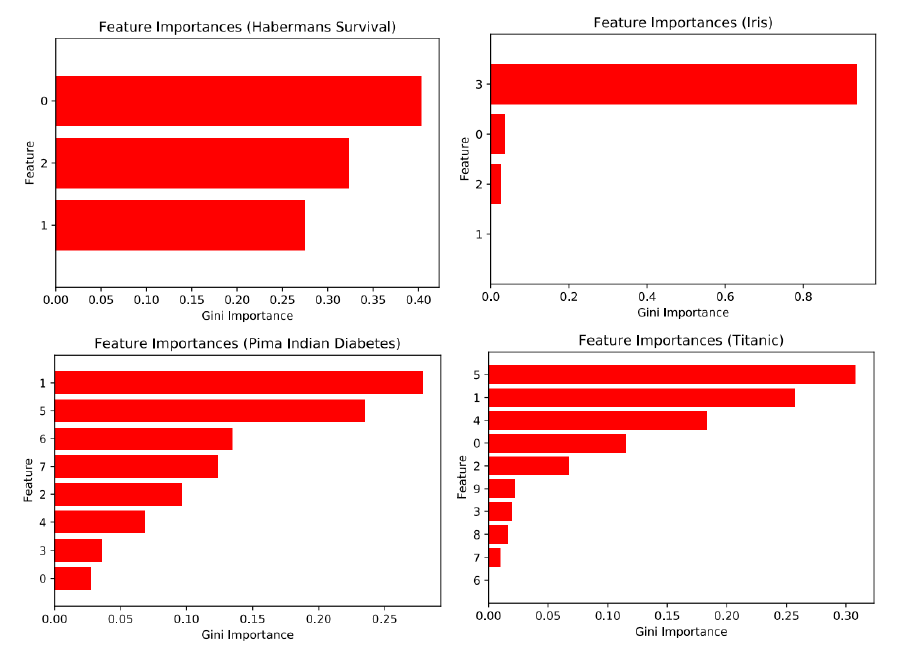
, , DNDT DT , , Iris 3 . , , , DT 0 , DNDT . DNDT 2 , DT. . . 2, DNDT DT 70,9% 66,1% .
, DNDT DT, Tau . , .4, .

4.7 GPU
, DNDT - , DT. , , (. . 6).
5.
DNDT. , NN , . , DT, DNDT , SGD GPU. . ; DNDT , CNN, ; , SGD DNDT , «» DT ; , NN DT.
Abadi, Mart´ın, Agarwal, Ashish, Barham, Paul, Brevdo, Eugene, Chen, Zhifeng, Citro, Craig, Corrado, Greg S., Davis, Andy, Dean, Jeffrey, Devin, Matthieu, Ghemawat, Sanjay, Goodfellow, Ian, Harp, Andrew, Irving, Geoffrey, Isard, Michael, Jia, Yangqing, Jozefowicz, Rafal, Kaiser, Lukasz, Kudlur, Manjunath, Levenberg, Josh, Mane, Dandelion, Monga, Rajat, Moore, ´ Sherry, Murray, Derek, Olah, Chris, Schuster, Mike, Shlens, Jonathon, Steiner, Benoit, Sutskever, Ilya, Talwar, Kunal, Tucker, Paul, Vanhoucke, Vincent, Vasudevan, Vijay, Viegas, Fernanda, Vinyals, Oriol, Warden, Pete, Wattenberg, Martin, Wicke, Martin, Yu, Yuan, and Zheng, Xiaoqiang. TensorFlow: Large-scale machine learning on heterogeneous systems, 2015. URL https://www.tensorflow.org/.
Balestriero, R. Neural Decision Trees. ArXiv e-prints, 2017.
Bengio, Yoshua. Estimating or propagating gradients through stochastic neurons. CoRR, abs/1305.2982, 2013.
Bostrom, Nick and Yudkowsky, Eliezer. The ethics of artificial intelligence, pp. 316334. Cambridge University Press, 2014.
Breiman, L., H. Friedman, J., A. Olshen, R., and J. Stone, C. Classification and Regression Trees. Chapman & Hall, New York, 1984.
Breiman, Leo. Random forests. Machine Learning, 45(1): 5–32, October 2001.
Bul, S. and Kontschieder, P. Neural decision forests for semantic image labelling. In CVPR, 2014.
Chen, Tianqi and Guestrin, Carlos. Xgboost: A scalable tree boosting system. In KDD, 2016.
Chung, J., Ahn, S., and Bengio, Y. Hierarchical Multiscale Recurrent Neural Networks. In ICLR, 2017.
Dash, S., Malioutov, D. M., and Varshney, K. R. Learning interpretable classification rules using sequential rowsampling. In ICASSP, 2015.
Doshi-Velez, Finale; Kim, Been. Towards a rigorous science of interpretable machine learning. ArXiv e-prints, 2017.
Dougherty, James, Kohavi, Ron, and Sahami, Mehran. Supervised and unsupervised discretization of continuous features. In ICML, 1995.
Ho, Tin Kam. The random subspace method for constructing decision forests. IEEE Transactions on Pattern Analysis and Machine Intelligence, 20(8):832–844, 1998.
Jang, E., Gu, S., and Poole, B. Categorical Reparameterization with Gumbel-Softmax. In ICLR, 20
Kim, B., Gilmer, J., Viegas, F., Erlingsson, U., and Wattenberg, M. TCAV: Relative concept importance testing with Linear Concept Activation Vectors. ArXiv e-prints, 2017.
Kim, Been, Khanna, Rajiv, and Koyejo, Sanmi. Examples are not enough, learn to criticize! Criticism for interpretability. In NIPS, 2016.
Kontschieder, P., Fiterau, M., Criminisi, A., and Bul, S. R. Deep neural decision forests. In ICCV, 2015.
Lecun, Yann, Bengio, Yoshua, and Hinton, Geoffrey. Deep learning. Nature, 521(7553):436–444, 5 2015.
Malioutov, Dmitry M., Varshney, Kush R., Emad, Amin, and Dash, Sanjeeb. Learning interpretable classification rules with boolean compressed sensing. In Transparent Data Mining for Big and Small Data, pp. 95–121. Springer International Publishing, 2017.
Norouzi, Mohammad, Collins, Maxwell D., Johnson, Matthew, Fleet, David J., and Kohli, Pushmeet. Efficient non-greedy optimization of decision trees. In NIPS, 2015.
Paszke, Adam, Gross, Sam, Chintala, Soumith, Chanan, Gregory, Yang, Edward, DeVito, Zachary, Lin, Zeming, Desmaison, Alban, Antiga, Luca, and Lerer, Adam. Automatic differentiation in pytorch. In NIPS Workshop on Autodiff, 2017.
Pedregosa, F., Varoquaux, G., Gramfort, A., Michel, V., Thirion, B., Grisel, O., Blondel, M., Prettenhofer, P., Weiss, R., Dubourg, V., Vanderplas, J., Passos, A., Cournapeau, D., Brucher, M., Perrot, M., and Duchesnay, E. Scikit-learn: Machine learning in Python. Journal of Machine Learning Research, 12:2825–2830, 2011.
Quinlan, J. Ross. C4.5: Programs for Machine Learning. Morgan Kaufmann Publishers Inc., 1993.
Ribeiro, Marco Tulio, Singh, Sameer, and Guestrin, Carlos. ”why should i trust you?”: Explaining the predictions of any classifier. In KDD, 2016.
Schmidhuber, J. Aprendizaje profundo en redes neuronales: una descripción general. Redes neuronales, 61: 85-117, 2015.
Weller, Adrian. Desafíos para la transparencia. En ICML Workshop on Human Interpretability in Machine Learning, págs. 55–62, 2017.
Wolpert, David H. La falta de distinciones a priori entre algoritmos de aprendizaje. Computación neuronal, 8 (7): 1341-1390, 1996.
Xiong, Zheng, Zhang, Wenpeng y Zhu, Wenwu. Árboles de decisión de aprendizaje con aprendizaje por refuerzo. En el Taller NIPS sobre metaaprendizaje, 2017.