En Habré hay muchos artículos sobre el tema ELF, que solo la gente no hace con ellos, explican su dispositivo, los ensamblan manual y automáticamente, editan, encriptan y mucho más. Yo, a mi vez, me gustaría compartir un caso interesante, en mi opinión, que me introdujo de inmediato a muchos aspectos de la programación de bajo nivel en la práctica:
compilación de programas,
una especie de ingeniería inversa y portabilidad de bibliotecas en tiempo de ejecución,
archivos ejecutables del dispositivo Windows y Linux,
ensamblar y editar dichos archivos manualmente
Estos y algunos otros aspectos, así como muchos movimientos no estándar, se abordarán al migrar el compilador . Al mismo tiempo, la parte del trabajo relacionada con los archivos ejecutables (y los ELF en particular) me pareció la más interesante, por lo que se convertirá en el leitmotiv del artículo.
Este artículo no es un tutorial exhaustivo, pero puede ser de interés para los lectores interesados en una o más de las áreas anteriores y listos para descubrir (o repasar) enfoques no estándar para resolver problemas en estas áreas.
En el curso del trabajo necesitamos:
compilador gcc, enlazador ld, depurador gdb
utilidades de binutils (readelf, strip, hexdump)
comprensión básica de los dispositivos portátiles ejecutables (PE) y ELF
Pascal
, Bero TinyPascal Compiler (, BTPC) 2016 - Pascal, (Benjamin Rosseaux). Pascal' (Delphi 7-XE7 FreePascal >= 3) Windows x32. , .
github . , , :
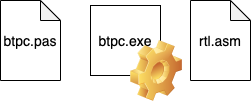
BTPC ( btpc.exe) self-contained - - ~3 . . - , , , . , , .
Pascal', , - -, , -, . , . " ".
Seg fault
BTPC - PE (Portable Executable, Mircosoft), .. "ELF Windows". , ELF, , - .
, PE 2
Portable Executable (PE) — , , Microsoft Windows. PE , , PE- . , API- ..
PE COFF Unix. «» PE — ELF ( Linux Unix) Mach-O ( Mac OS X).
, , Pascal, , , -:
-
- "-"
- "" PE-
PE- , "" .
- . , (Runtime Library, RTL).
Runtime Library 2
RTL- - CRT C/C++. , , , .. , , .
- pre-start post-exit "", main' . , , main, ( ), main .
PE- RTL 9 :
RTLHalt —
RTLWriteChar — char’ stdout
RTLWriteInteger — integer' stdout
RTLWriteLn — linebreak' stdout
RTLReadChar — EAX STDIN
RTLReadInteger — EAX integer' STDOUT
RTLReadLn — STDIN EOF ( )
RTLEOF — EAX EOF. 0 — .
RTLEOLN — 1 DL, - \n, 0 —
- , :
.ENTRYPOINT
JMP StubEntryPoint #
RTLHalt:
... # RTLHalt
RTLWriteChar:
...
... # RTL
RTLFunctionTable: #
DD OFFSET RTLHalt
DD OFFSET RTLWriteChar
DD OFFSET RTLWriteInteger
...
StubEntryPoint:
INVOKE HeapAlloc ... #
MOV ESI, OFFSET RTLFunctionTable #
ProgramEntryPoint:
, RTL, :
StubEntryPoint
ESI
… , ProgramEntryPoint !
, , BTPC ProgramEntryPoint.
, 2 - .
: btpc.pas rtl.asm . btpc.pas blob, :
{ }
procedure EmitStubCode;
begin
OutputCodeDataSize := 0;
OutputCodeString(#77#90#82#195#66#101#82#111#94#102#114#0#80#69#0#0#76#1#1#0#0#0#0#0#...
OutputCodeString(#0#0#0#0#0#0#0#0#0#0#0#0#0#0#16#0#0#0#16#0#0#143##16#0#0#0#0...
OutputCodeString(#0#0#0#0#0#0#0#0#0#0#255#255#255#255#40#16#0#0#53#0#0#0...
OutputCodeString(#101#110#106#97#109#105#110#32#39#66#101#82#111#...
OutputCodeDataSize := 1423;
end;
{ }
- Pascal- , rtl.asm.
, PE .
, :
RTL ( ) , PE- ( , - )
PE- - ( , 255 )
, - NOP
- ( )
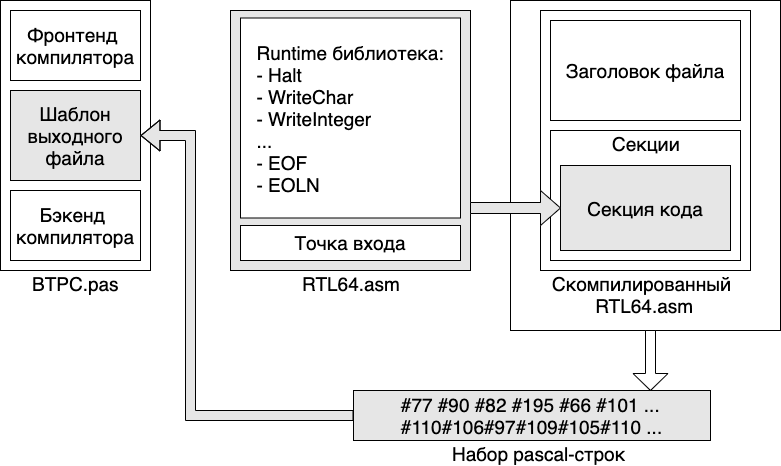
BTPC :
stdin
, -
, -
( - PE-)
, "" , ,
PE32
: - . , , . , , ( ). : , , , .
: 4 , 156 . 100 . , 4 , 100 .
, RTL, Excagena, - PE-. / , Excagena , .
-, PE. , , ProgramEntryPoint - , .
- - PE-. - :
(OptionalHeader.SizeOfCode)
(SectionTable.VirtualSize)
(OptionalHeader.SizeOfImage),
- , , :
{ }
CodeSize := OutputCodeGetInt32($29) + (OutputCodeDataSize - CodeStart);
OutputCodePutInt32($29, CodeSize);
{ }
SectionAlignment := OutputCodeGetInt32($45);
{ }
SectionVirtualSize := CodeSize;
Value := CodeSize mod SectionAlignment;
SectionVirtualSize := SectionVirtualSize + (SectionAlignment - Value);
OutputCodePutInt32($10d, SectionVirtualSize);
{ }
OutputCodePutInt32($5d, SectionVirtualSize + OutputCodeGetInt32($39));
, $29, $45, $115 …
, - Linux x64 . , :
RTL Linux x64
ELF-
ELF-,
- 3

- "" WinApi .
, , . . - , Win32 API, :
ReadCharBuffer: DB 0x90
ReadCharBytesRead: DB 0x90,0x8D,0x40,0x00
ReadCharEx:
PUSHAD
INVOKE ReadFile, DWORD PTR StdHandleInput, OFFSET ReadCharBuffer, 1, OFFSET ReadCharBytesRead, BYTE 0
TEST EAX, EAX
SETZ AL
OR BYTE PTR IsEOF, AL
CMP DWORD PTR [ReadCharBytesRead], 0
SETZ AL
OR BYTE PTR IsEOF, AL
POPAD
RET
, , . , - " " - ReadCharBuffer ReadCharBytesRead. , …

- , , . ( - , - , - ), .
, 64- syscall ( ). , RDI, RSI, RDX . RAX.
x64 pusha, pushad, popa, popad. pushall, popall, . - bss.
, - data.
:
.section .data # -
ReadCharBuffer:
.byte 0x3c
.section .text # -
ReadCharEx:
PUSHALL # - bss
XORQ %RAX, %RAX # syscall #0: read(int fd, void *buf, size_t count)
XORQ %RDI, %RDI # fd : 0 == stdin
MOVQ $ReadCharBuffer, %RSI # buf : ReadCharBuffer
MOVQ $1, %RDX # count : 1 byte
SYSCALL
CMPQ $0, %RAX
SETZ %BL
ORB %BL, (IsEOF)
POPALL
RET
, - . , - , Guard Page.
, , Linux , , , Segmentation fault. , , . , . Guard Page . , , , , .
:
$ gcc -c rtl64.s $ ld rtl64.o -g --output rtl64
ELF - BTPC . .
, BTPC - EmitByte:
procedure OCPopESI;
begin
EmitByte($5e);
LastOutputCodeValue := locPopESI;
end;
procedure OCMovzxEAXAL;
begin
EmitByte($0f);
EmitByte($b6);
EmitByte($c0);
LastOutputCodeValue := locMovzxEAXAL;
end;
, , x64. - ,
1 -
MOV R10, [R12 + R13]
, (, ) "Intel 64 and IA-32 Architectures Developer’s Manual"

. - – R10 "R?".
MOV i8086+. "r/m →R?". , 0x8B.
R10 4 , 3 Rn ModR/M.
"" " REX".
R10 R REX Rn ModR/M.
ModR/M 32- , R/M ModR/M = 100, Mod = 00. SIB.
R12, 1, X REX SIB.
SIB , [#Base + #Index2^(Scale)]. Base R12. 3 = 100 3 Base SIB.
(Index) SIB 3 R13 = 101.
(1 + 1 ), Scale SIB = 00 2^(Scale) = 2^0 = 1.
R13 B REX. SIB.
REX: "0100" + "W:1" + "R:1" + "X:1" + "B:1" = 01001111, hex 0x4F. REX .
ModR/M: "Mod:00" + "Rn:010" + "R/M:100" = 00010100, 0x14.
SIB: "Scale:00" + "Index:101" + "Base:100" = 00101100, 0x2C.
MOV R10, (R12 + R13)
0x4F 0x8B 0x14 0x2C
.
, PE- , , . , BTPC 70 .
: , , .
.
ELF'
, , BTPC - , , "" , , , . .
, , - ELF' - ELF'.
, . 2 :
ELF64 PE32
PE32 ,
readelf' rtl64:
$ readelf --section-headers rtl64 Section Headers: [Nr] Name Type Address Offset Size EntSize Flags Link Info Align [ 0] NULL 0000000000000000 00000000 0000000000000000 0000000000000000 0 0 0 [ 1] .text PROGBITS 00000000004000b0 000000b0 0000000000000317 0000000000000000 AX 0 0 1 [ 2] .data PROGBITS 00000000006003c7 000003c7 00000000000000bf 0000000000000000 WA 0 0 1 [ 3] .symtab SYMTAB 0000000000000000 00000488 0000000000000408 0000000000000018 4 39 8 [ 4] .strtab STRTAB 0000000000000000 00000890 0000000000000248 0000000000000000 0 0 1 [ 5] .shstrtab STRTAB 0000000000000000 00000ad8 0000000000000027 0000000000000000 0 0 1
- ELF' 6 !:
( )
— text
— data
— shstrtab (Section header string table)
symtab
strtab

, . - . ProgramEntryPoint , " ".
? . , 4 , , ELF'.
ld (--nostdlib, --strip-all):
$ ld rtl64.o -g --output rtl64-min -nostdlib --strip-all
ELF 2 - 1.4 . :
$ readelf --section-headers rtl64-min Section Headers: [Nr] Name Type Address Offset Size EntSize Flags Link Info Align [ 0] NULL 0000000000000000 00000000 0000000000000000 0000000000000000 0 0 0 [ 1] .text PROGBITS 00000000004000b0 000000b0 0000000000000317 0000000000000000 AX 0 0 1 [ 2] .data PROGBITS 00000000006003c7 000003c7 00000000000000bf 0000000000000000 WA 0 0 1 [ 3] .shstrtab STRTAB 0000000000000000 00000486 0000000000000017 0000000000000000 0 0 1
2 . , shstrtab . , binutils strip, . shstrtab :
$ strip -R shstrtab rtl64-min $ readelf --section-headers rtl64-min Section Headers: [Nr] Name Type Address Offset Size EntSize Flags Link Info Align [ 0] NULL 0000000000000000 00000000 0000000000000000 0000000000000000 0 0 0 [ 1] .text PROGBITS 00000000004000b0 000000b0 0000000000000317 0000000000000000 AX 0 0 1 [ 2] .data PROGBITS 00000000006003c7 000003c7 00000000000000bf 0000000000000000 WA 0 0 1 [ 3] .shstrtab STRTAB 0000000000000000 00000486 0000000000000017 0000000000000000 0 0 1
Shstrtab . , :
$ hexdump -C rtl64-min 00000480 40 00 00 00 00 00 00 2e 73 68 73 74 72 74 61 62 |@.......shstrtab| 00000490 00 2e 74 65 78 74 00 2e 64 61 74 61 00 00 00 00 |..text..data....| 000004a0 00 00 00 00 00 00 00 00 00 00 00 00 00 00 00 00 |................|
… ! . , .shstrtab . , , - , .
, ( ). . , .
, :
ENTRY(_start) /* */
SECTIONS
{
. = 0x4000b0; /* */
.data : { *(.data) }
.bss : { *(.bss) *(COMMON) }
. = 0x6000d3; /* */
.text : { *(.text) } /* */
}
ld - . , , ld --verbose
- , , . .
. :
$ ld rtl64.o -g --output rtl64-custom-ld -T linkerScript.ld -nostdlib --strip-all $ readelf --section-headers rtl64-custom-ld Section Headers: [Nr] Name Type Address Offset Size EntSize Flags Link Info Align [ 0] NULL 0000000000000000 00000000 0000000000000000 0000000000000000 0 0 0 [ 1] .data PROGBITS 00000000006000b0 000000b0 00000000000000bf 0000000000000000 WA 0 0 1 [ 2] .text PROGBITS 0000000000a00170 00000170 0000000000000317 0000000000000000 AX 0 0 1 [ 3] .shstrtab STRTAB 0000000000000000 00000487 0000000000000017 0000000000000000 0 0 1
, ! text, , data.
, , . gdb, - , , , , .
, - gdb . , …
, , , symtab strtab , . , - - ( , .. )
, . , , . stackoverflow , , . :
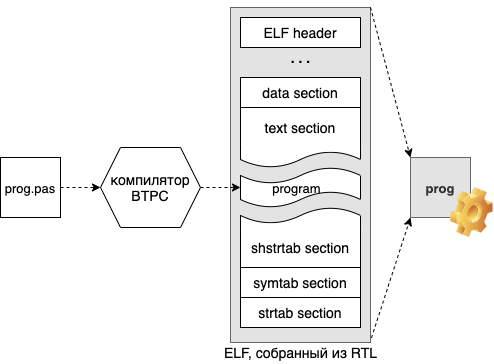
, , :
|
|
Elf__hdr.e__shoff |
0x28 |
Text_phdr.p_filesz |
sizeof(Elf__hdr) + sizeof(p_hdr) + 0x20 |
Text_phdr.p_memsz |
sizeof(Elf_hdr) + sizeof(p_hdr) + 0x28 |
Text_shdr.sh_size |
Elf_hdr.e_shoff + sizeof(injection) + 2*sizeof(s_hdr) + 0x20 |
Shstrtab_shdr.sh_offs |
Elf_hdr.e_shoff + sizeof(injection) + 3*sizeof(s_hdr) + 0x18 |
Symtab_shdr.sh_offs |
Elf_hdr.e_shoff + sizeof(injection) + 4*sizeof(s_hdr) + 0x18 |
Strtab_shdr.sh_offs |
Elf_hdr.e_shoff + sizeof(injection) + 5*sizeof(s_hdr) + 0x18 |
: sizeof(injection). .
, , ELF', - , , , .
, , "", "" "", .
. , ELF, , . - . , RTL.
.
- bootstrapping
#
$ btpc.exe < btpc64.pas > btpcCrossWin.exe
# Linux–
$ btpcCrossWin.exe < btpc64.pas > btpc64Linux
# , «» , Linux
$ btpc64Linux < btpc64.pas > btpc64Check
Pascal, Linux x64, .
, , . :
BTPC
, Pascal Windows
(RTL)
RTL ELF
, , , . , - . , ,
P.S.
, , . , , 9 . , . . , , , . , ( " ?") . , , , "", , ("" ).
Además, no puedo dejar de agradecer a mi asesor científico, Alexander Konovalov.
Como se señaló al principio, este artículo no tenía la intención de explicar el dispositivo ELF, enseñar cómo realizar trucos locos en ellos o programas de puerto. Pero usando un ejemplo real, ella, espero, mostró cuán atípicas pueden ser las soluciones de problemas ordinarios, qué cosas interesantes se pueden observar en el curso de la resolución y qué descubrimientos hacer por uno mismo ... Y tal vez ella anime a alguien a dar el primer paso hacia el siguiente. desafío inexplorado pero emocionante ...