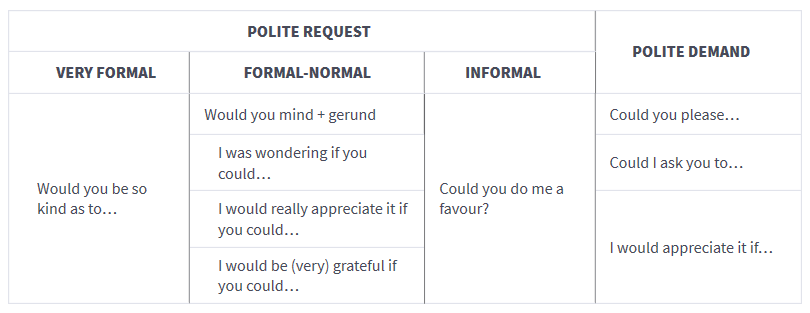
Todos nosotros en nuestro trabajo a menudo nos enfrentamos a la necesidad de acudir a alguien en busca de ayuda. En inglés, la diferencia entre una solicitud cortés y una demanda de hacer algo puede ser difícil de entender, porque hay reglas bien establecidas basadas en costumbres y normas generalmente aceptadas más que en lógica. Sin embargo, es muy importante sentir esta diferencia. Al manejar mal, no solo podemos no lograr el resultado deseado, sino también ofender al interlocutor. Como probablemente ya sepa, en inglés, a diferencia de muchos otros, simplemente agregar "por favor" no es suficiente. Nuestro colega, Scott Boyce, capacitador de idiomas de EPAM, analizó varias formas de escribir consultas en inglés y observó errores comunes.
El artículo será especialmente útil para aquellos que a menudo tienen que comunicarse en inglés en el trabajo.
Cómo pedirle educadamente a alguien que haga algo
Mente
'Mente' en el contexto de las solicitudes significa objetar / tener algo en contra. Oralmente, esta frase se puede usar para hacer una demanda en lugar de una solicitud, según la entonación y el contexto. Sin embargo, por escrito, esto generalmente se considera una solicitud, por ejemplo:
¿Le importaría enviar eso antes de que acabe el día?
Tenga en cuenta que a la mente le sigue un gerundio. No podemos usar el infinitivo, es decir. no puedes decir:
¿Te importaría enviar <…>?
Para hacer esta solicitud aún más educada, puede poner un adverbio adecuado después de la palabra ' mente' :
Would you mind terribly sending that before the end of the day?
, , , ‘no’, ‘yes’― , :
No, I don’t mind doing that at all.
Favour
:
Could you do me a (big) favour? Can you send me that before the end of the day?
, ‘do’, ‘make’. ( , ‘favour’ ‘u’ ― ‘favor’).
Wonder
:
I was wondering if you could send me that before the end of the day.
, — ‘was wondering’ ‘could’. «» ‘mind’, ‘favour’ ‘wonder’, :
I was wondering if you would mind doing me a huge favour.
Appreciate
:
I would really appreciate it if you could send it to me before the end of the day.
, ‘it’. ‘appreciate’ ! - .
‘really’ ‘very’. , ‘very’ (. . — , , much: I would very much appreciate it …).
, ‘really’, , :
I would appreciate it if you could send it to me before the end of the day.
Grateful
‘Grateful’ ‘appreciate’. , ‘grateful’ — , (no ‘it’!):
I’d be really grateful if you could send it to me before the end of the day.
(‘grateful’ — ), ‘really’ ‘very’.
‘appreciate’, ‘really’/’very’ — .
Kind
, ‘Would you be so kind<…>’ , EPAM. , . :
Would you be so kind AS to send that to me before the end of the day?
, ‘as’, "so... as...".
, « » ( ). , , , . , ; :
“No, 'tis not so deep as a well, nor so wide as a church door, but 'tis enough.”
21 ‘so’ (, , ) ‘as’. , :
“No, it’s not as deep as a well, nor as wide as a church door, but it’s enough.”
“Would you be so kind as to <…>” — . , , . , - - ( ), .
- (Telling someone to do something)
, ‘could’. , :
Could you please send that to me before the end of the day?
, , — , , — , , . .
, ‘please’, ‘ask’:
Could I ask you to send that to me before the end of the day?
, , , :
, !
:
“Go wisely and slowly. Those who rush stumble and fall.” .. « . , , ». , : « ― ».