
En este artículo, utilizando el ejemplo de expresiones lógicas simples, se le mostrará qué es un árbol de sintaxis abstracta y qué puede hacer con él. También se considerará una alternativa a las expresiones LINQ para ejecutar consultas en bases de datos SQL.
Historia del desarrollador
Era un proyecto heredado y se me pidió que mejorara sus capacidades de filtrado "avanzadas".
Solían tener algo como esto:

Y querían algo como esto:
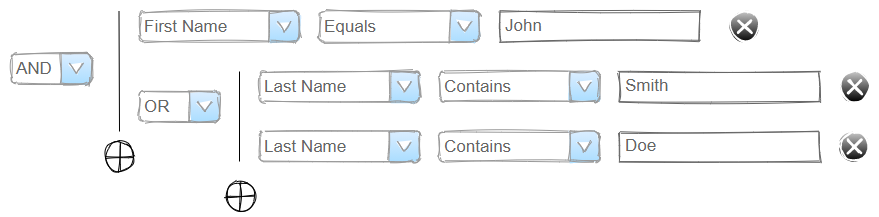
, «» :
CREATE PROCEDURE dbo.SomeContextUserFind
    (@ContextId int, @Filter nvarchar(max)) AS
BEGIN

DECLARE @sql nvarchar(max) =
    N'SELECT U.UserId, U.FirstName, U.LastName
    FROM [User] U
    INNER JOIN [SomeContext] [C]
      ON ....
    WHERE [C].ContextId = @p1 AND ' + @Filter;

EXEC sp_executesql

    @sql,
    N'@p1 int',
    @p1=@ContextId
END
, , :
string BuildFilter(IEnumerable<FilterItem> items)
{
    var builder = new StringBuilder();
    foreach (var item in items)
    {
        builder.Append(item.Field);
        bool isLike = false;
        switch (item.Operation)
        {
            case Operation.Equals:
                builder.Append(" = ");
                break;
            case Operation.Like:
                isLike = true;
                builder.Append(" LIKE ");
                break;
            //...
        }
        builder.Append('\'');
        if (isLike)
            builder.Append('%');
        builder.Append(Escape(item.Value));
        if (isLike)
            builder.Append('%');
        builder.Append('\'');
    }
    return builder.ToString();
}
, , - , , , ( ) . , , , - .
, , — «FilterItem» , , , .
« », , , , , .
-, , , :
[FirstName]='John' AND ([LastName]='Smith' OR [LastName]='Doe'):
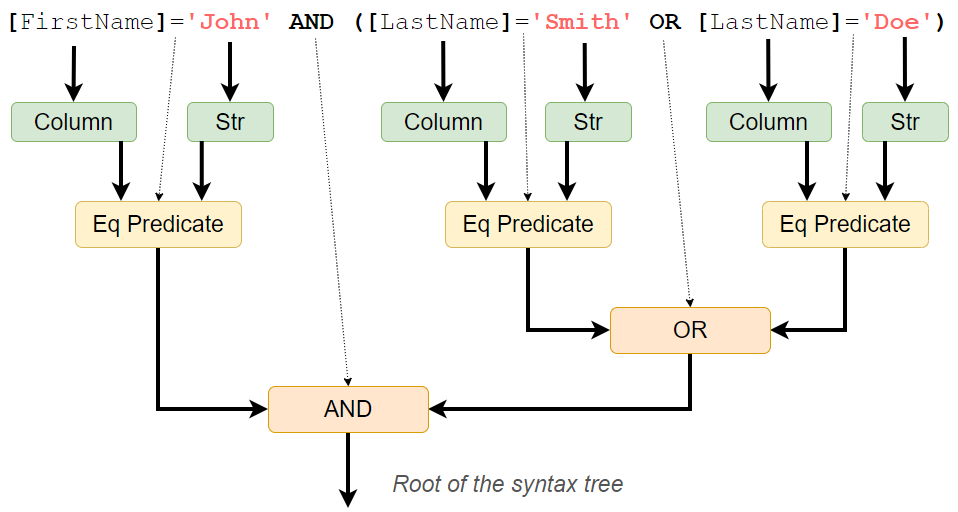
, , , :

abstract class Expr
{ }

class ExprColumn : Expr
{
    public string Name;
}

class ExprStr : Expr
{
    public string Value;
}

abstract class ExprBoolean : Expr
{ }

class ExprEqPredicate : ExprBoolean
{
    public ExprColumn Column;
    public ExprStr Value;
}

class ExprAnd : ExprBoolean
{
    public ExprBoolean Left;
    public ExprBoolean Right;
}

class ExprOr : ExprBoolean
{
    public ExprBoolean Left;
    public ExprBoolean Right;
}
, , :
var filterExpression = new ExprAnd
{
    Left = new ExprEqPredicate
    {
        Column = new ExprColumn
        {
            Name = "FirstName"
        },
        Value = new ExprStr
        {
            Value = "John"
        }
    },
    Right = new ExprOr
    {
        Left = new ExprEqPredicate
        {
            Column = new ExprColumn
            {
                Name = "LastName"
            },
            Value = new ExprStr
            {
                Value = "Smith"
            }
        },
        Right = new ExprEqPredicate
        {
            Column = new ExprColumn
            {
                Name = "LastName"
            },
            Value = new ExprStr
            {
                Value = "Doe"
            }
        }
    }
};
, , « », , «», .
« » — ( ) ( ) . . , ( ) :
<eqPredicate> ::= <column> = <str>
<or> ::= <eqPredicate>|or|<and> OR <eqPredicate>|or|<and>
<and> ::= <eqPredicate>|(<or>)|<and> AND <eqPredicate>|(<or>)|<and>
: «» , , , , . .
— , , , , .
SQL
, , .
— (Pattern Matching), :
var filterExpression = ...;

StringBuilder stringBuilder = new StringBuilder();
Match(filterExpression);

void Match(Expr expr)
{
    switch (expr)
    {
        case ExprColumn col:
            stringBuilder.Append('[' + Escape(col.Name, ']') + ']');
            break;
        case ExprStr str:
            stringBuilder.Append('\'' + Escape(str.Value, '\'') + '\'');
            break;
        case ExprEqPredicate predicate:
            Match(predicate.Column);
            stringBuilder.Append('=');
            Match(predicate.Value);
            break;
        case ExprOr or:
            Match(or.Left);
            stringBuilder.Append(" OR ");
            Match(or.Right);
            break;
        case ExprAnd and:
            ParenthesisForOr(and.Left);
            stringBuilder.Append(" AND ");
            ParenthesisForOr(and.Right);
            break;
    }
}

void ParenthesisForOr(ExprBoolean expr)
{
    if (expr is ExprOr)
    {
        stringBuilder.Append('(');
        Match(expr);
        stringBuilder.Append(')');
    }
    else
    {
        Match(expr);
    }
}
:
[FirstName]='John' AND ([LastName]='Smith' OR [LastName]='Joe'), !
""
, - — « (Visitor)». , , ( ), , . :
interface IExprVisitor
{
    void VisitColumn(ExprColumn column);
    void VisitStr(ExprStr str);
    void VisitEqPredicate(ExprEqPredicate eqPredicate);
    void VisitOr(ExprOr or);
    void VisitAnd(ExprAnd and);
}
( ) :
abstract class Expr
{
    public abstract void Accept(IExprVisitor visitor);
}

class ExprColumn : Expr
{
    public string Name;

    public override void Accept(IExprVisitor visitor)
        => visitor.VisitColumn(this);
}

class ExprStr : Expr
{
    public string Value;

    public override void Accept(IExprVisitor visitor)
        => visitor.VisitStr(this);
}
...
sql :
class SqlBuilder : IExprVisitor
{
    private readonly StringBuilder _stringBuilder
        = new StringBuilder();

    public string GetResult()
        => this._stringBuilder.ToString();

    public void VisitColumn(ExprColumn column)
    {
        this._stringBuilder
            .Append('[' + Escape(column.Name, ']') + ']');
    }

    public void VisitStr(ExprStr str)
    {
        this._stringBuilder
            .Append('\'' + Escape(str.Value, '\'') + '\'');
    }

    public void VisitEqPredicate(ExprEqPredicate eqPredicate)
    {
        eqPredicate.Column.Accept(this);
        this._stringBuilder.Append('=');
        eqPredicate.Value.Accept(this);
    }

    public void VisitAnd(ExprAnd and)
    {
        and.Left.Accept(this);
        this._stringBuilder.Append(" AND ");
        and.Right.Accept(this);
    }

    public void VisitOr(ExprOr or)
    {
        ParenthesisForOr(or.Left);
        this._stringBuilder.Append(" OR ");
        ParenthesisForOr(or.Right);
    }

    void ParenthesisForOr(ExprBoolean expr)
    {
        if (expr is ExprOr)
        {
            this._stringBuilder.Append('(');
            expr.Accept(this);
            this._stringBuilder.Append(')');
        }
        else
        {
            expr.Accept(this);
        }
    }

    private static string Escape(string str, char ch)
    {
        ...
    }
}
:
var filterExpression = BuildFilter();

var sqlBuilder = new SqlBuilder();
filterExpression.Accept(sqlBuilder);
string sql = sqlBuilder.GetResult();
:
[FirstName]='John' AND ([LastName]='Smith' OR [LastName]='Joe')" (Visitor)" . , , , IExprVisitor , , ( ).
, .
-, ?
, , sql :
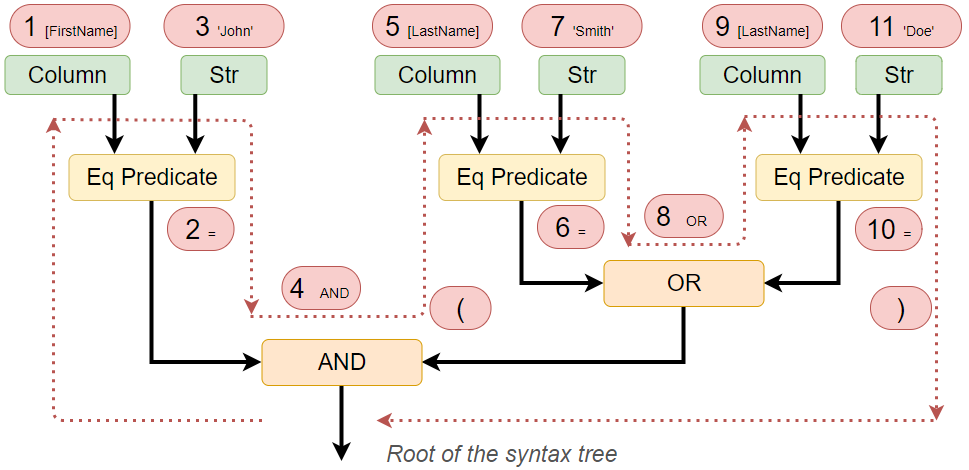
, , .
-, ?
, . «» , «» — . , . ( ), .
, , “NotEqual”, () , :
class ExprNotEqPredicate : ExprBoolean
{
    public ExprColumn Column;
    public ExprStr Value;

    public override void Accept(IExprVisitor visitor)
        => visitor.VisitNotEqPredicate(this);
}
, , SQL:
public void VisitNotEqPredicate(ExprNotEqPredicate exprNotEqPredicate)
{
    exprNotEqPredicate.Column.Accept(this);
    this._stringBuilder.Append("!=");
    exprNotEqPredicate.Value.Accept(this);
}
, , MS SQL , , , .
, SQL Server SQL, :

, . C#. :
class ExprColumn : Expr
{
    ...
    public static ExprBoolean operator==(ExprColumn column, string value)
        => new ExprEqPredicate
        {
            Column = column, Value = new ExprStr {Value = value}
        };

    public static ExprBoolean operator !=(ExprColumn column, string value)
        => new ExprNotEqPredicate
        {
            Column = column, Value = new ExprStr {Value = value}
        };
}

abstract class ExprBoolean : Expr
{
    public static ExprBoolean operator &(ExprBoolean left, ExprBoolean right)
        => new ExprAnd{Left = left, Right = right};

    public static ExprBoolean operator |(ExprBoolean left, ExprBoolean right)
        => new ExprOr { Left = left, Right = right };
}
:
ExprColumn firstName = new ExprColumn{Name = "FirstName"};
ExprColumn lastName = new ExprColumn{Name = "LastName"};

var expr = firstName == "John" & (lastName == "Smith" | lastName == "Doe");

var builder = new SqlBuilder();
expr.Accept(builder);
var sql = builder.GetResult();
:
[FirstName]='John' AND ([LastName]='Smith' OR [LastName]='Doe'): C# && ||, , , ( true || ....), ( SQL).
, , ? - - (View Derived Table) ( ) .
! SQL SELECT:
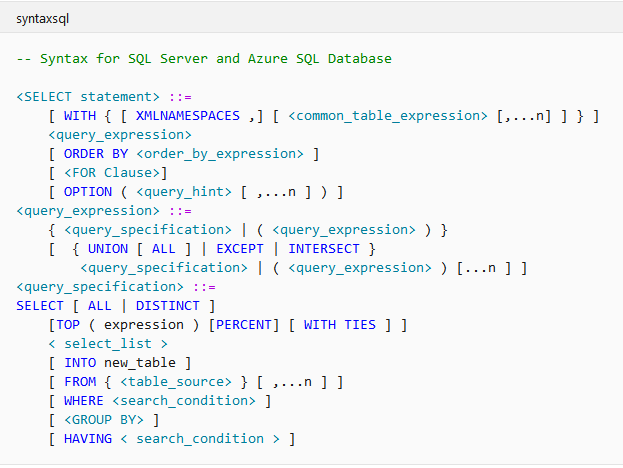
, , (, ), , SQL.
LINQ
, , LINQ, . C# , , Entity Framework «LINQ to SQL», SQL.
, C#, SQL! C# SQL – , .
— C# SQL. , .
, , , . , , intellisense - . … , LEFT JOIN LINQ)
, (INSERT, UPDATE, DELETE MERGE) , .
Solo un ejemplo de lo que se puede hacer usando la sintaxis SQL real como base ( tomado de aquí ):
await InsertInto(tCustomer, tCustomer.UserId)
    .From(
        Select(tUser.UserId)
            .From(tUser)
            .Where(!Exists(
                SelectOne()
                    .From(tSubCustomer)
                    .Where(tSubCustomer.UserId == tUser.UserId))))
    .Exec(database);
Conclusión
El árbol de sintaxis es una estructura de datos muy poderosa con la que es probable que se encuentre tarde o temprano. Tal vez sean expresiones LINQ, o tal vez necesite crear un analizador de Roslyn, o tal vez desee crear su propia sintaxis usted mismo, como hice hace unos años, para refactorizar un proyecto heredado. En cualquier caso, es importante comprender esta estructura y poder trabajar con ella.
Link to SqExpress es un proyecto que incluye parcialmente el código de este artículo.